Aller au contenu principal

Becoming a Teacher for Social Change

Datum

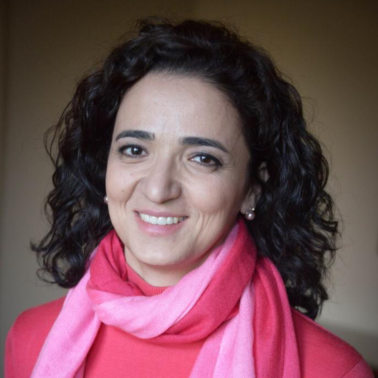
Dr. Wadiaa Khoury, Founder-TASC, Lebanon

Dr. Wadiaa Khoury

My decision to pursue education sciences as a major—and later to found Teachers as Agents of Social Change (TASC)—did not emerge from a single moment of clarity. It unfolded gradually, shaped by innumerable experiences and transformative encounters that helped me understand the power of education in shaping individuals and societies.

Growing up as the fifth child, I witnessed how differently intelligence manifests itself. My eldest sister excelled academically and became a dermatologist. My brother, a school dropout, demonstrated exceptional practical intelligence—building machines, repairing engines, and managing our family’s agricultural land with ingenuity. Another sister became a pharmacist and yet another, a psychologist.

What struck me deeply was how the school system interpreted these differences. Teachers often asked me whether I would be “intelligent” like my eldest sister or “a stuggle” like my brother. This comparison planted a lasting question in my mind: 

Why does education recognize only one type of intelligence while overlooking others? 

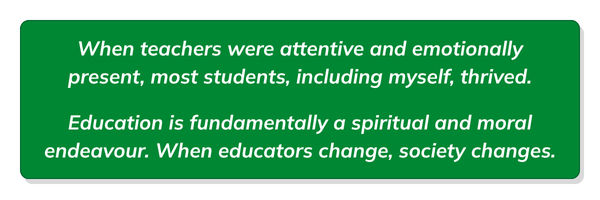
My whole schooling was paralleled by the events of the civil war in Lebanon and its aftermath. In primary school, I performed very well academically despite the ongoing anxiety. In high school my performance varied substantially across subjects. When teachers were attentive and emotionally present, most students, including myself, thrived. When the teachers were distant or disengaged, my level of interest in the subject suffered. The teachers that impressed most students often spared time to encourage open discussions about meaning, responsibility, and identity.

Through them, I discovered that education is never purely academic. It shapes character, purpose, and belonging. 

After high school, I felt called not just to practice a profession but to understand human development and the educational systems that shape lives. I chose to study education sciences. While I was introduced to various angles of education sciences, I gravitated toward civic education and policy, inspired particularly by a series of courses on civics that revealed how teachers can influence not only students but entire societies.
Teachers as Agents of Social Change (TASC) 


A major turning point came in 2001 when I joined Action for Life, a leadership programme led by IofC International. For eleven months, I travelled across India and East Asia, visiting educational institutes in various countries. In India, the ETST programme emphasized character formation, deep listening, and social responsibility. Across East Asia, I observed how education, when rooted in ethical principles and civic responsibility, can foster cohesive, ethical and resilient societies. When I returned to Lebanon, I became increasingly aware of my country’s urgent need for reconciliation and reform. I began teaching at the International College in Beirut. Later, I became the coordinator of the college’s community service programme and dealt annually with nearly 700 Lebanese baccalaureate students, integrating civic engagement and reflection into their learning journeys. This role shaped my capacity to organize and supervise multiple projects and sensitize students to real social needs.

At the same time, I pursued a law degree at the Lebanese University. While academically enriching, this experience exposed me to systemic corruption, favouritism, and ethical compromises. Books can be written about the approach of every teacher and administrator. Some were uniting, others were dangerously divisive, in a faculty mandated to prepare future lawyers, judges and civil servants. These experiences reinforced a central conviction: education is a moral act. Teachers shape minds and moral values, long before the need for law enforcement.

In 2010, I joined Professor Rajmohan Gandhi on a Voyage of Trust across Africa and Europe. One sentence he repeated became a guiding principle for me: “If you want to be great, make sure your followers are greater than you.” I immediately thought of teachers. Their success lies in empowering others and guiding them to fulfil their calling in a holistic way that is based on virtue. During this journey, I decided to completely dedicate my life to education as the deeper path to societal healing. I pursued a PhD in education sciences and began forming future educators at university, emphasizing active and virtuous leadership in the roles of teachers as agents of positive social change.

A visit to Iraq after the 2010 massacre in a church in Karrada, Baghdad, uncovered the destructive role of teachers when they contribute to the radicalization of students. While on the other hand, teachers took the initiative to lead reconstruction shifts following a terrorist explosion in Beirut, and gave back rehabilitated homes to 70 families in record time. It became crystal clear: a teacher can be an agent of death or an agent of life!

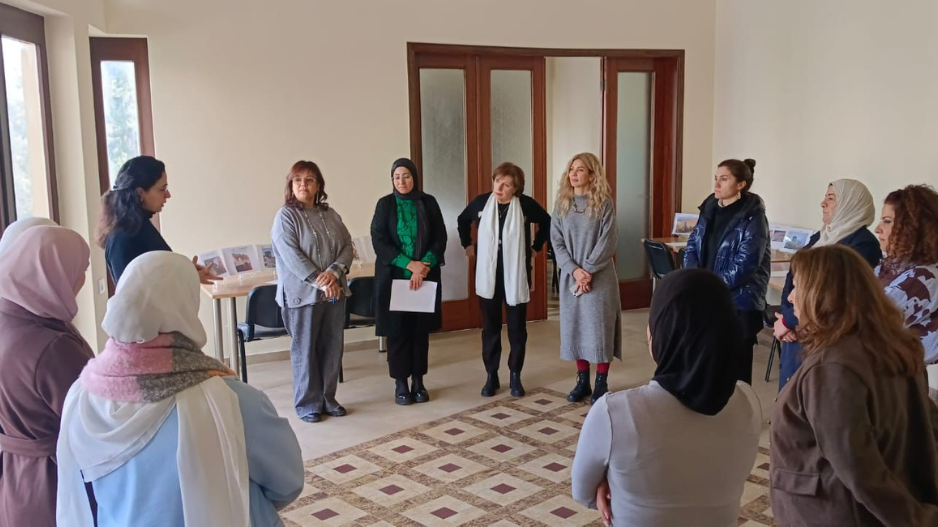
The Lebanese uprising and financial collapse in 2019 intensified polarization and uncertainty. Recognizing educators’ need for safe spaces to reflect and rebuild trust, I initiated dialogue forums where teachers could share their stories, fears, and aspirations. These gatherings evolved into the first educators’ trust circles in Lebanon. They revealed how deeply teachers longed for connection, meaning, and collective responsibility.

During a Fulbright scholarship in the United States in 2020, thinking deeply about the teacher’s TASC led to the acronym TASC (Teachers as Agents of Social Change). The name captured both identity and mission: teachers are not passive implementers of policy but active agents shaping society. Since its founding in 2022, TASC has worked with schools across Lebanon, bringing together educators from diverse backgrounds. It has developed programmes and training tools on active citizenship, good governance, social justice, and reconciliation.

Despite challenges and delays, TASC has continued to grow through persistence and community support. Looking ahead, it aims to expand trust circles nationwide. TASC recently launched a podcasting program called “Educators”, highlighting educators’ stories and reinforcing the idea that teachers are central to social transformation. TASC recently became a partner of the Ministry of Education and Higher Education (MEHE) in Lebanon, in the National Strategy for Social Cohesion; a strategy that was developed with MEHE to counterbalance the deep divisions in Lebanon following the outbreak of the 2024 and 2026 wars.