In 1995 this awareness compelled me to move from formal teaching to be free to develop a programme in Sixth Forms all round Britain, doing interactive sessions to provoke thought about purpose in life and motivation. This was under the umbrella of IofC. During the years following that the focus was on small teams of younger people who spent the autumn and spring terms visiting schools. Countries represented in these teams include Australia, Brazil, Czech Republic, Germany, Honduras, India, Japan, Latvia, Mexico, New Zealand, Nigeria, Poland, Russia, Slovakia, Somalia, South Africa, South Korea, Sudan, UK, USA, Ukraine and Zimbabwe.
We used themes such as:
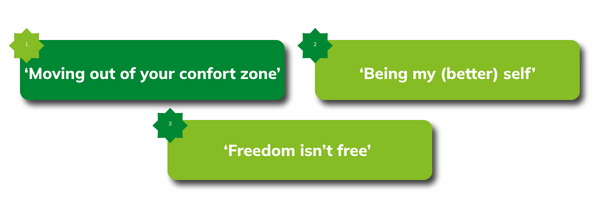
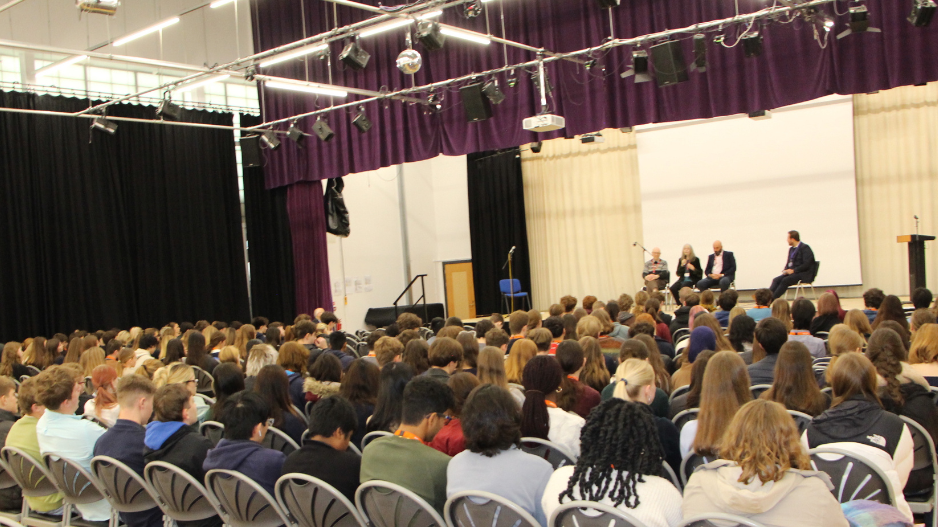
to focus on the inner struggle which we all experience. Rather than talking about specific subjects like ‘drugs’, our themes aimed to create a broader context from which all issues could get a perspective. Our teams facilitated about 800 sessions in Sixth Forms, often with groups of about 60 to 100 students for an hour. We went to tough inner-city state schools and to privileged independent colleges, interacting with some 50,000 students.
As an example, a few years after the fall of the Soviet Union, two people aged 18 and 20, from Latvia and Russia joined us. They told the sixth formers,
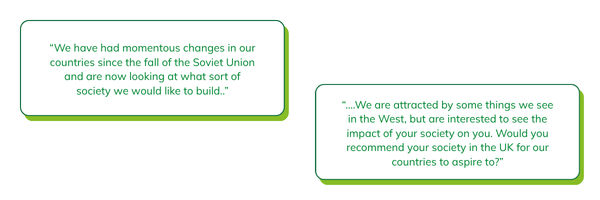
We also often quoted someone as saying, “In the West, in the UK we have everything to live with but nothing to live for.” After asking the students if they agreed with this statement (some did and some didn’t) we then asked:
“What do you live for if you basically have all you need? Is it ‘more of the same’? Or is it something else?”
and
“Why is it that in our society, when many basically have what they need, there is so much depression, drugtaking or even suicide?”
Questions like these prompted deeper thought, and enabled discussion on what the students felt is important to them.
Our sessions were interactive, not prescriptive, in the spirit of enquiry which is needed to get the modern generation involved. Teachers commented on the importance of questions like these which enabled ‘lateral thinking’. The sessions finished with a brief time of silence to reflect on these questions. Teachers often remarked about the effectiveness of these, as much for themselves as for the students. One teacher said of the whole session, 'You were speaking directly to me.’
Following the London underground bombings in 2005, which killed 52 people and led to great anti Muslim feeling. Musa Aliyu (Nigerian student), Amina Khalid (Somali refugee) and I facilitated sessions in about sixty Sixth Forms. Our theme was Raising a generation of trust-builders. We wanted to present a different narrative to the divisive one which had been generated by the bombings. Musa led the sessions and started by asking the students:
“Why would two young African Muslims and a relatively old English Christian want to work together to visit schools like this?”
When Amina was introduced, she shared some of her experiences as a young person in Somalia, growing up in a civil war zone. For instance her uncle was shot dead by a neighbour who was an 'enemy'. Also at the age of eight she was playing outside with her four-year-old cousin, when he was shot and wounded in front of her. Her family had ended up as refugees in London, where she was sent to school at the age of 13, hardly speaking any English. She was bullied and racially abused, partly because of wearing a headscarf.
She went to four different schools, and had a horrid time. This led to some thoughtful discussion. She asked the students for feedback on:
What she should have done in that situation, try to fight back or to walk away?