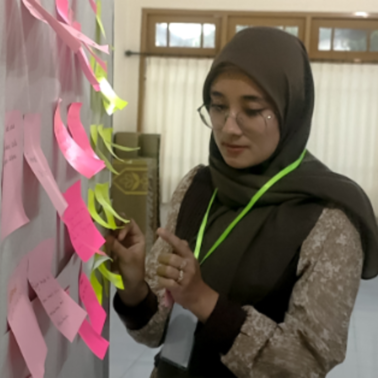
When Hanny began her master’s studies at the Center for Religious and Cross-Cultural Studies (CRCS) at Universitas Gadjah Mada, Yogyakarta, she was already engaged in youth empowerment and peace building initiatives across Indonesia.
But beneath her passionate activism lay unresolved questions - questions about why violent narratives, especially those targeting minorities, persisted so stubbornly across generations.
These questions stirred something deeper within Hanny, prompting her to explore interfaith dialogue and reconciliation.
She began joining various interfaith programs - both locally and internationally - hoping to uncover insights that would shed light on these troubling patterns. It wasn’t until a close friend, Ninis, encouraged her to join the Trustbuilding Program that Hanny encountered the turning point she didn’t know she needed.
One session, themed “Healing Historical Wounds,” challenged Hanny in ways she hadn’t expected. She came searching for answers about others - why people hurt, provoke, or discriminate - but the program gently turned that lens inward. One particular moment stood out: when participants were asked, “Is your activism rooted in love, or is it a reflection of your own unhealed wounds?” That question hit Hanny hard.
For the first time, she realized that her drive to create change might be intertwined with her own hidden pain - pain she hadn’t fully acknowledged. This realization didn’t weaken her - it deepened her. As she examined her past experiences and emotional scars, she began to see a larger truth: many of the conflicts she had been fighting against weren’t just political or social - they were deeply personal. They stemmed from wounds passed down, buried, and ignored.
Through the Trustbuilding Program, Hanny came to believe that healing - both personal and collective - is not only possible, but essential. She learned that authentic leadership begins with self-awareness and vulnerability. And she embraced a powerful new perspective: reconciliation, though slow and difficult, is within reach if we’re willing to first make peace within ourselves.
This shift in perspective marked the beginning of Hanny’s transformation. No longer just an advocate for peace, through the TBP she became a facilitator of healing. She began initiating dialogue sessions in her community, focusing on personal stories rather than abstract theories. Her goal wasn’t to win arguments or offer quick fixes - it was to create safe, empathetic spaces where people could share, listen, and understand one another’s pain.
By turning inward, Hanny found the strength to reach outward in a new, more compassionate way. Her journey reminds us that the path to peace doesn’t always start with solving the world’s problems, it starts with the courage to face our own.